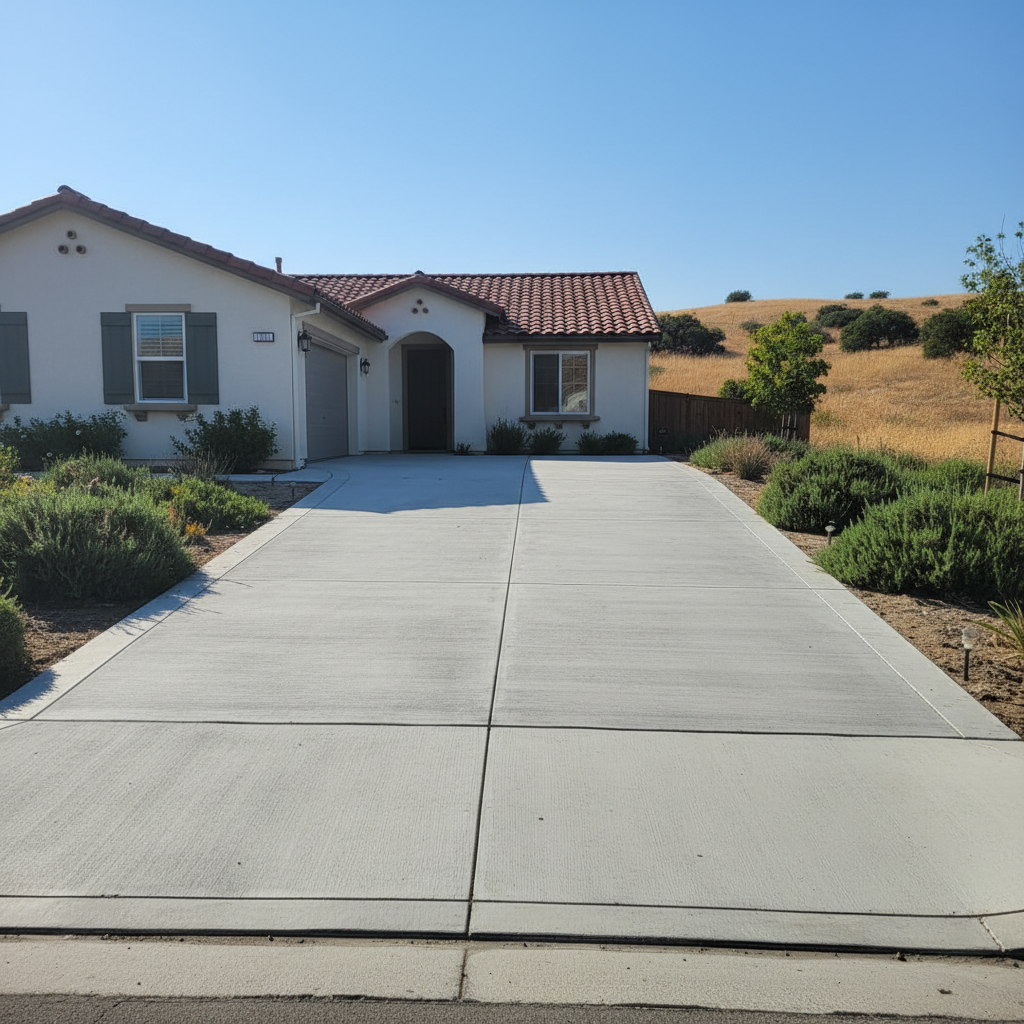
Concrete work looks simple from the curb. A truck shows up, grey stuff gets poured, a few days later it's hard and grey and people walk on it. What actually determines whether that slab is still flat and crack-free in fifteen years happens underground and on paper, before the truck ever arrives. Most of it you'll never see once it's done. That's exactly why picking the right contractor matters more here than the final color or finish does.
Start with the license, not the logo
In California, concrete flatwork and structural work fall under a C-8 contractor's license through the CSLB. You can look up any license number on the CSLB website in under a minute and see if it's active, what classification it covers, and whether there have been complaints against it. Do this before you do anything else. A contractor who hesitates when you ask for their license number, or who tells you a license isn't necessary for a driveway or patio because it's "just flatwork," is telling you something important.
Ask for proof of general liability insurance and workers' comp too. If a worker gets hurt on your property and the crew isn't covered, that liability can land on you as the homeowner. This is one of the few parts of hiring a contractor that's genuinely black and white. Either the paperwork exists or it doesn't.
Read the bid like a spec sheet, not a price
Two bids for the same driveway can look close on price and be nowhere close in what you're actually getting. A real bid should tell you the slab thickness, the PSI of the mix, how the base is prepared, and whether reinforcement is rebar or wire mesh.
- Standard driveway slabs run about 4 inches thick over 4 to 6 inches of compacted aggregate base. If a contractor skips the base compaction step to save a day, the slab will likely settle unevenly within a few years, especially where a car sits in the same spot every day.
- Rebar on roughly 18-inch centers holds a cracked slab together so it doesn't heave or separate. Wire mesh is cheaper and fine for light-duty patios, but it tends to sag to the bottom of the pour if nobody pulls it up during placement, which defeats the point of it.
- Control joints should be cut every 8 to 10 feet, within about 24 hours of the pour. Concrete is going to crack somewhere as it cures and shrinks. A joint just tells it where to crack instead of leaving it to choose.
If a bid is one line that just says "driveway, 500 sq ft, $X," that's not a bid. That's a guess with a price attached.
Ask who's pulling the permit
The City of San Mateo requires a building permit for most new slabs, retaining walls over a few feet, and any replacement of a driveway apron or sidewalk section, since that work touches the public right of way. Apron and curb work specifically usually needs an encroachment permit on top of the building permit, because you're altering city property, not just your own lot. A contractor who's done work here regularly should know this without you having to bring it up.
If you're in one of the townhome complexes around Sugarloaf or the newer developments near Hillsdale, check with your HOA before signing anything. Some require approval on color, finish, or even the contractor's insurance limits before work starts. Older single-family streets in Baywood or Hayward Park rarely have this layer, but it's worth a two-minute call to find out rather than finding out after the concrete's down.
Walk away from any contractor who tells you permits are "usually not needed" for this kind of job or offers to do it "off the books" to save time. That's not a shortcut. It's a sign the inspection step, which catches rebar placement and base depth before the pour gets covered up, is one they'd rather skip.
What the ground around here actually does
San Mateo sits on a mix of soil types depending on which part of town you're in, and it genuinely changes how a job should be built. Neighborhoods like Shoreview, Parkside, and parts of Bayside sit on filled land near the bay flats, built up decades ago over what used to be tidal marsh. That fill can be soft and settle unevenly over time, which means base prep and compaction aren't optional steps, they're the whole ballgame for whether your slab stays level.
Up in the hills, around the San Mateo Highlands or the areas off Crystal Springs Road, you get more clay content in the native soil. Clay expands when wet and contracts hard when it dries out over the summer. A slab poured directly on clay without enough compacted base under it will move with the season, and that movement shows up as cracking at the weakest point, usually right where a joint should have been cut but wasn't.
A contractor who's worked this area for a while will ask about your soil before they quote you, not after they've already poured. If they don't ask, ask them.
Timing, weather, and what "done" actually means
San Mateo doesn't get hard freezes, so freeze-thaw cracking isn't the issue it is inland or back east. The bigger scheduling factor here is the rainy season, roughly November through March, when a contractor needs to plan around storms rather than pour into one. Rain on fresh concrete before it sets can wash out the surface finish and weaken the top layer.
Once it's poured, you can typically walk on a new slab in 24 to 48 hours. Driving a car on it takes about 7 days. Full cure, where the concrete reaches its design strength, is closer to 28 days. Any contractor who tells you it's fine to park a car on a 2-day-old driveway either doesn't know better or doesn't care, and neither is who you want handling your project.
Coastal fog actually works in your favor here. It keeps the surface cooler during curing than you'd get inland, which slows evaporation and tends to produce a stronger, less crack-prone finish than a pour done in dry summer heat 30 miles east.
The short version
Check the license yourself instead of taking their word for it. Get a bid with real numbers in it, not just a price. Ask who's handling the permit and don't let anyone talk you out of one. And find someone who already knows what your soil does, because that part of the job is the part you'll never see again once the concrete's down. If you want to talk through a specific job, you can see the kind of work we do at Apex Concrete Solutions.